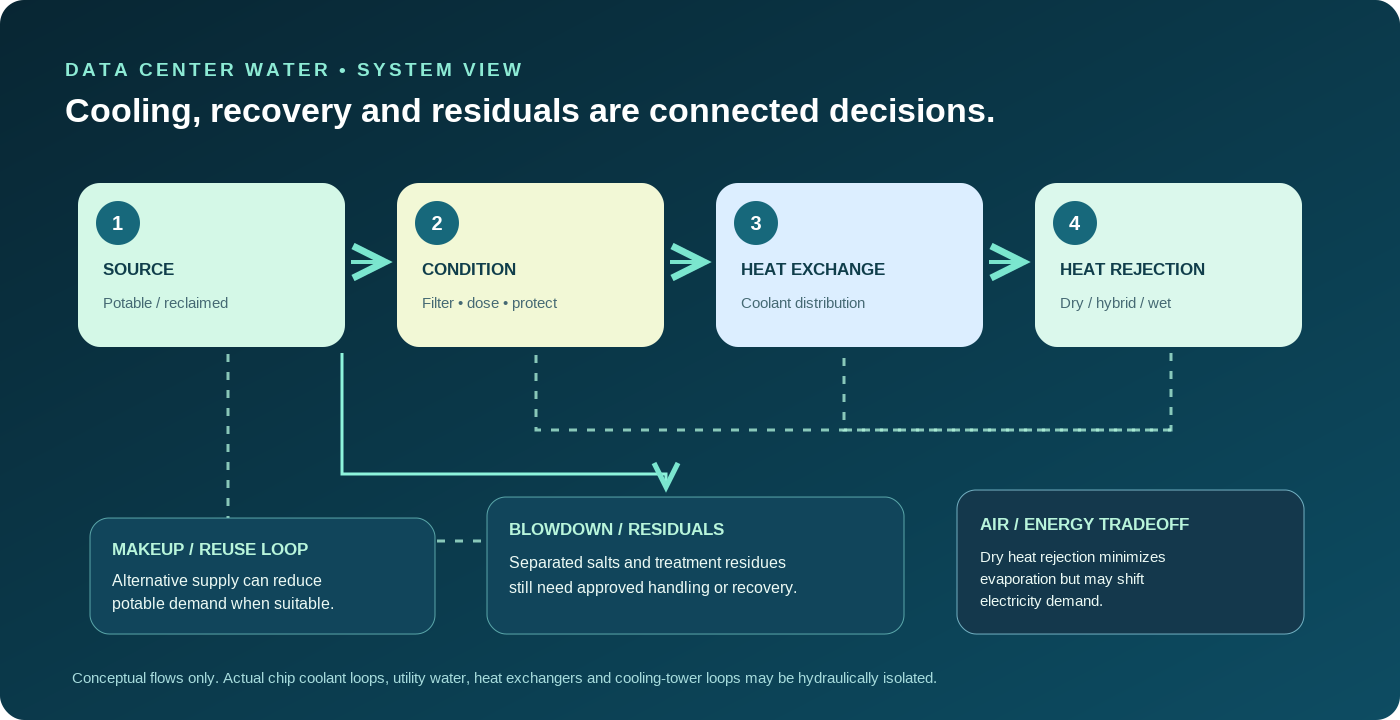
1. How is water used in a data center?
Servers, storage and networking equipment dissipate heat. A facility may move that heat through air handlers, chilled-water systems or direct-to-chip cold plates. Liquid-cooling loops can recirculate with little routine water replacement; cooling towers can evaporate water to the atmosphere, requiring additional makeup. Other facility uses, including humidification, domestic needs and maintenance, also exist. Cooling architecture must therefore be described alongside the heat-rejection method and the source of replacement water.
2. Compare four cooling strategies.
| Approach | Water consequence | Critical tradeoff |
|---|---|---|
| Evaporative cooling towers | Routine evaporative loss and blowdown; makeup is needed | Energy efficiency versus freshwater demand and water treatment |
| Dry coolers and air-cooled chillers | Little or no onsite evaporative water use | Electricity, ambient temperature, heat-rejection capacity |
| Direct-to-chip cooling | Closed chip coolant circuit; facility heat rejection still matters | Coolant cleanliness, leak management, CDU reliability and facility topology |
| Immersion cooling | Dielectric fluid carries chip heat; secondary rejection varies | Materials compatibility, maintenance, heat exchanger and fluid handling |
No single cooling technology minimizes both energy and water impacts everywhere. Climate, compute density, carbon intensity, peak water stress and available alternative supplies matter.
3. A cooling-water recycling pathway.
- Map the water balance. Measure withdrawal, makeup, evaporation, blowdown, drift and other discharges, using consistent time intervals.
- Evaluate alternative sources. Treated municipal effluent, captured rainwater and selected onsite recycled streams may offset potable supplies when water quality and permits allow.
- Condition and protect the loop. Control scaling, corrosion, microbiological growth, suspended solids and temperature effects without creating uncontrolled chemical waste.
- Recover where feasible. Treat blowdown or other suitable streams using separation technologies to produce fit-for-purpose makeup, while accounting for energy and recovery limits.
- Handle residuals. Concentrated salts, backwash, spent media and chemical residues need documented, approved routes.
- Verify the result. Track real withdrawals, WUE, potable-water displacement, water quality, energy demand and operating cost—not just theoretical recovery.
4. What the new research is telling us.
Recent studies look beyond facility-level consumption. They consider electricity-generation water use, local climate, cooling tower chemistry, the relationship between water and thermal efficiency, and how AI workloads shift the demand. A 2025 Lawrence Berkeley National Laboratory-authored study found wide variability in workload water footprints, warning against assigning one simplistic water-use number to every computation. A 2026 thermal management review explores the link between cooling architecture and measured WUE.
Microsoft reported a 2025 average owned-fleet WUE of 0.27 L/kWh and described closed-loop direct-to-chip systems designed to avoid evaporative cooling water in operation. Those numbers are company-reported performance, not an industry-wide baseline or a guarantee that indirect water footprints disappear.
5. A real reuse example: Quincy, Washington.
The US EPA documents a partnership between Microsoft and the City of Quincy that built a reuse utility for data-center cooling water, allowing cooling water to be treated and recirculated for the same use. This helps reduce pressure on local potable groundwater sources. It demonstrates how a data-center water strategy can connect onsite equipment to municipal water infrastructure rather than relying on a single skid-mounted filter.
6. Questions for the next data-center project.
- What are the site-specific heat loads, IT profile and design weather conditions?
- Which water supplies exist, and which are already stressed or regulated?
- Does the proposed heat-rejection strategy add electric peak-load risk?
- What water quality does the technology cooling system (TCS) require?
- Where do cooling-tower blowdown, membrane concentrate and spent media go?
- Which losses are measured as withdrawals, consumption, return flow and reuse?
- How will efficiency claims be independently monitored over time?
Our calculators estimate WUE, direct liquid cooling flow, cooling tower concentration and makeup, and recovered water versus concentrate volume. Every output declares its assumptions.
Open the water and cooling calculator lab ↗Sources and further reading
- US Department of Energy — Cooling water efficiency for federal data centers
- US EPA — Water reuse for industrial applications; Quincy case example
- Microsoft — 2026 water stewardship and reported WUE
- Berkeley Lab — Data-center workload water use review (2025)
- Fluids — 2026 review of water usage and cooling architectures
Technical editorial, not a facility design. Reported industry figures have different boundaries and may not apply to a proposed data center. Potable-water substitution and wastewater treatment require local water-quality approval.