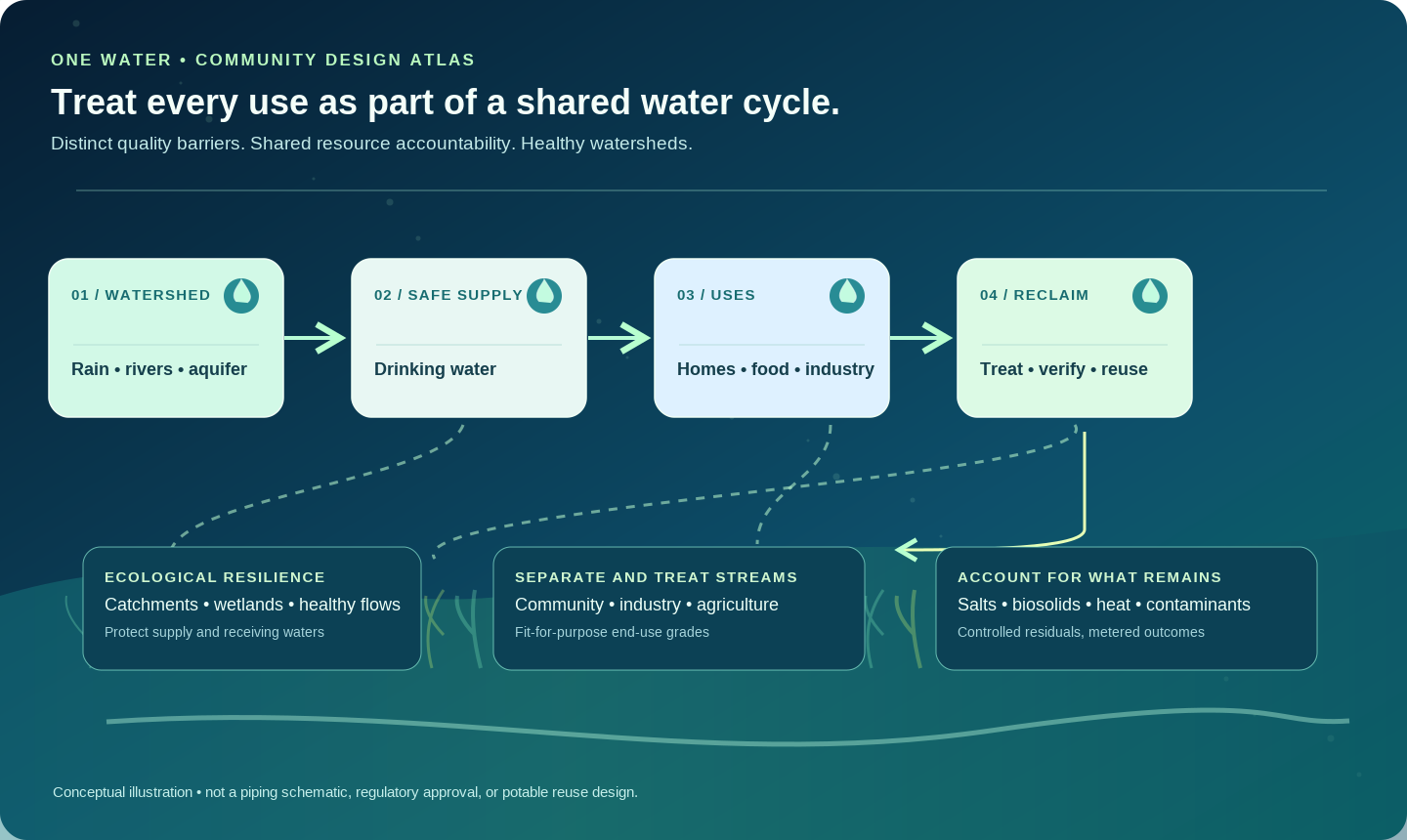
A practical example: planning a new water-sensitive district
Imagine a community expanding housing, high-density computing, a food-production cluster and protected river habitat. The first map should not only show roads and property lines. It should show the water budget: seasonally available resources, low-flow periods, groundwater recharge, environmental allocations, drinking-water needs, treatment capacity and acceptable discharge destinations.
Residential buildings can be designed with efficient fixtures and, where approved, segregated greywater or blackwater treatment for clearly labelled nonpotable uses. Industrial systems should publish process-water grades and heat loads, seek source reduction, recover suitable streams and characterize brine or hazardous residuals. Agriculture needs water, nutrient and salinity plans. Landscape infrastructure can intercept runoff, improve habitat and handle eligible polishing loads without being confused with a drinking-water plant.
The utility and local government need monitoring, emergency response, separate piping and a fair cost allocation. Industrial operators should not reduce their own headline WUE by shifting untreated residuals, energy burdens or water scarcity onto the neighboring community.
Community water system performance scorecard
| Measure | What to track | Why it matters |
|---|
| Supply resilience | Seasonal source reliability, storage, drought planning, alternate supply | Prevents fragile growth dependent on a single source |
| Public health | Validated potable barriers, microbial and chemical compliance, response times | Water reuse cannot weaken drinking-water safety |
| Withdrawal / consumption | Freshwater intake, evaporation, stream returns, local watershed stress | Water withdrawn is not the same as water consumed |
| Fit-for-purpose reuse | Metered reclaimed volume and water-quality compliance by destination | Rewards reuse that truly replaces suitable source water |
| Ecosystem condition | River flows, nutrient loading, aquatic habitat and watershed monitoring | Protects the living system supporting the community |
| Waste and residuals | Salt mass, sludge, spent media, chemical discharge and final handling | A captured contaminant must not disappear from the accounting |
| Energy and costs | kWh/m³, treatment lifecycle costs, heat recovery and equity of charges | A solution must be affordable and not shift the burden elsewhere |
Water infrastructure should be designed for the people who live beside it.
Residents, Indigenous and Tribal governments where applicable, farms, utilities, businesses, regulators and watershed organizations should have meaningful ways to participate before water commitments are fixed. Long-term oversight should account for affordability, environmental justice, flood resilience, local economic opportunity, and the public right to information. A technically elegant process is not a success if it depletes a watercourse or makes safe supply unaffordable.
Where cutting-edge technology fits
Advanced membranes, engineered biofilms, high-recovery separation, sensor networks, digital models, low-water cooling and nature-based treatment can all contribute. None is the universal answer. The question is what a system can demonstrate for its water source and end use: validated quality, less withdrawal or consumption, lower pollution, workable residual handling, reliable operation and a fair lifecycle cost.
HydroTechnica's technology intelligence identifies companies and systems worth examining, while showing exactly what evidence is available and what has not been independently verified.
Explore technologies with evidence, not hype.Our innovation watch links to genuine projects, certification listings and technical source material. An entry means the approach deserves examination; it is not a paid endorsement or approval for procurement.
Browse the Water Innovation Watch ↗
Independent starting references
Planning framework, not a water-supply allocation, ecological impact assessment or licensed engineering design. Health, environmental and reuse requirements differ by jurisdiction and water source.