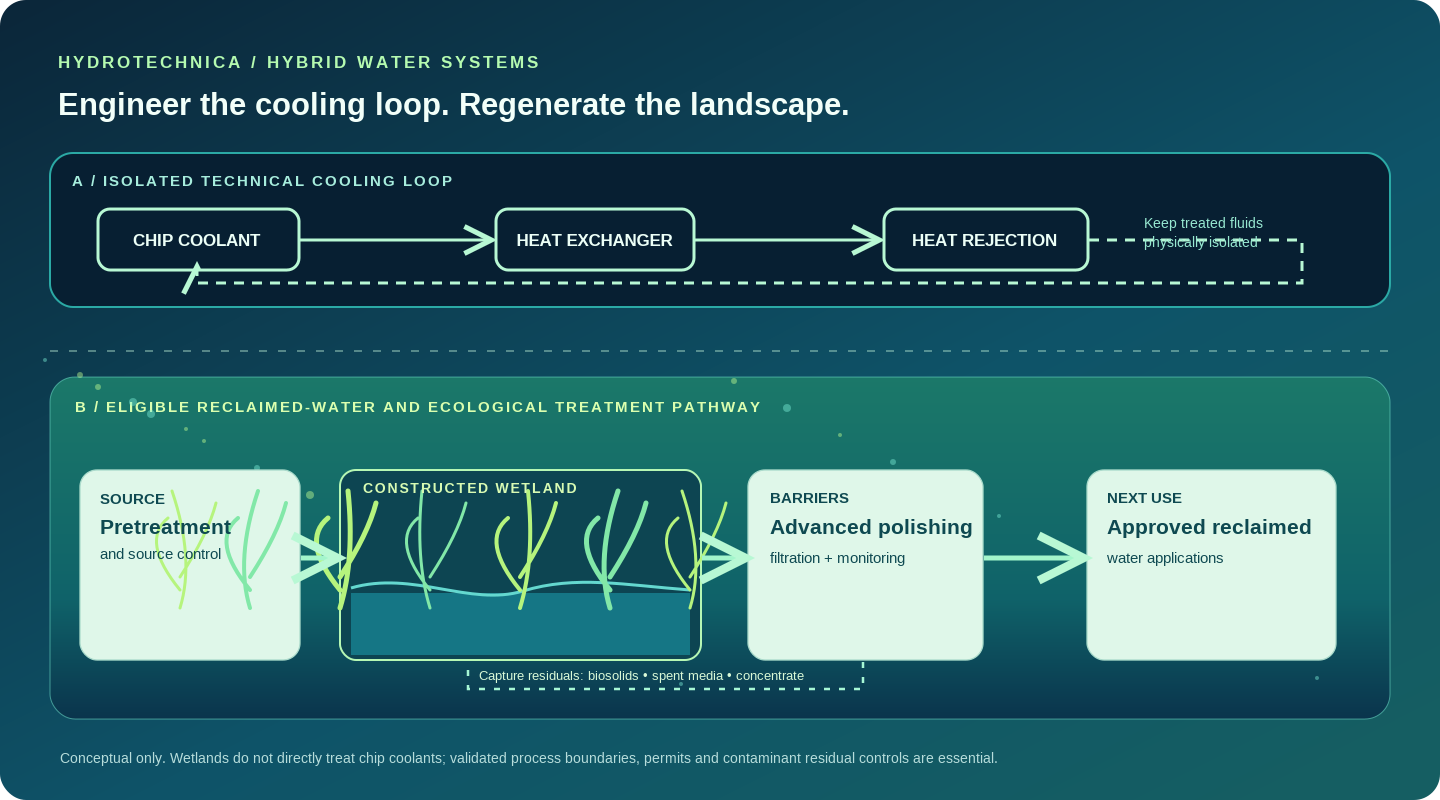
1. Keep the technical cooling loop isolated.
A direct-to-chip system may circulate carefully specified treated water or inhibited water-based coolant through cold plates. A cooling distribution unit (CDU) can separate that loop from a facility water system through a heat exchanger. The fluid's chemistry, corrosion inhibition, microbial control, particulate cleanliness and compatible materials must follow equipment requirements. An outdoor planted pond should not be directly plumbed into processor cold plates.
Cooling water, condenser water, tower water and non-potable landscape water may be four different streams with different water-quality rules. Site architecture should show these as separate systems, not an undifferentiated “closed water loop.”
2. Reduce heat demand before proposing evaporation or condensation.
Start with efficient IT hardware, airflow design and appropriate temperature setpoints. Then compare dry coolers, hybrid heat rejection and evaporative towers using the actual climate. Closed-loop heat transfer can reduce routine fluid replacement but does not necessarily eliminate water consumed at a cooling tower. Evaporating water removes heat efficiently but loses that water as vapour; deliberately condensing it again may require more energy and additional equipment than other approaches.
Useful waste heat can sometimes be directed to a nearby heat customer—buildings, a greenhouse or an approved thermal system—if the temperature and demand align. Heat-recovery economics depend on seasonality, distance, available temperature and backup systems.
3. Design nature-based functions around eligible water streams.
| Stream | Potential ecological contribution | Necessary safeguard |
|---|---|---|
| Roof and landscape stormwater | Rain gardens, bioswales, vegetated detention and recharge where appropriate | Site contamination screening, flood design and local discharge rules |
| Pre-treated domestic or municipal reclaimed supply | Constructed wetland polishing for selected nutrients and organics | Upstream treatment, disinfection where needed, pathogen validation, approved reuse classification |
| Cooling tower blowdown | Some segregated, characterized streams may be suitable for further treatment research | Scaling salts, biocides and corrosion inhibitors may make direct biological treatment unsuitable; concentrated reject remains |
| Chip cooling loop / inhibited coolants | Not a direct ecological treatment circuit | Keep physically separate; manufacturer-controlled quality, monitoring and spill management |
| Waste heat | Thermal energy for greenhouse growing or other useful nearby load | Heat exchanger, temperature match, reliable heat customer and backup rejection |
4. Restore the landscape without pretending contaminants vanish.
A green belt may support biodiversity, stormwater absorption, erosion control and public access. If it is asked to treat wastewater, however, that part must be designed as engineered treatment infrastructure with pretreatment, residence time, sampling, suitable plants and operating contingencies. A PFAS-laden or metal-rich stream may shift pollutants into sediment, media or biomass; it cannot simply be spread through habitat.
Research into biochar media, plant-associated microbiomes, microbial electrochemistry and hybrid wetlands is advancing. Those are promising tools, not universally certified removal technologies. For salt concentrate and hazardous industrial waste, specialized separation, destruction or permitted disposal may still be the correct endpoint.
5. Compare scenarios using honest metrics.
- Water: withdrawals, evaporation, return flows, alternate-source substitution, onsite WUE and water stress.
- Quality: chemistry, pathogens, source variability, monitoring uncertainty and exceedance response.
- Energy: heat rejected, heat recovered, peak demand and the power-water relationship.
- Residuals: sludge, wetland media, sorbents, salts, disinfectant residues and contamination risk.
- Reliability: seasonal operating limits, equipment redundancy, maintenance and regulatory performance.
Use the existing data-center water calculations to screen cooling flow, tower makeup and recovery. A later advanced module can model the complete water-energy-ecology mass balance with site constraints.
Open Water Tools Lab ↗Selected sources
- US DOE — Data-center cooling water efficiency, WUE and heat rejection
- ASHRAE — AI data-center cooling and heat-recovery practices
- US EPA — Constructed wetlands
- Government of Canada — Constructed wetland applications and climate limits
- 2026 review — Advanced constructed wetlands for emerging contaminants
Exploratory design principles only. This example is not an approved data-center cooling circuit, a guaranteed environmental treatment method or a substitute for site-specific engineering, permits and water-quality validation.