HydroTechnica
Water technologies / Ecology

High technology. Living systems. One water cycle.

Explore how ecological processes, plants, microbes, engineering and advanced purification can work together—and where natural treatment needs additional barriers.

ECOLOGICAL ENGINEERING / WATER FUTURES

Nature is not the opposite of technology. It can be part of the treatment train.

Engineered wetlands, planted bioreactors and biologically active treatment landscapes use organisms and environmental conditions to transform, retain or separate selected contaminants. They can add habitat and public value—but must be designed, measured, maintained and regulated as real infrastructure.

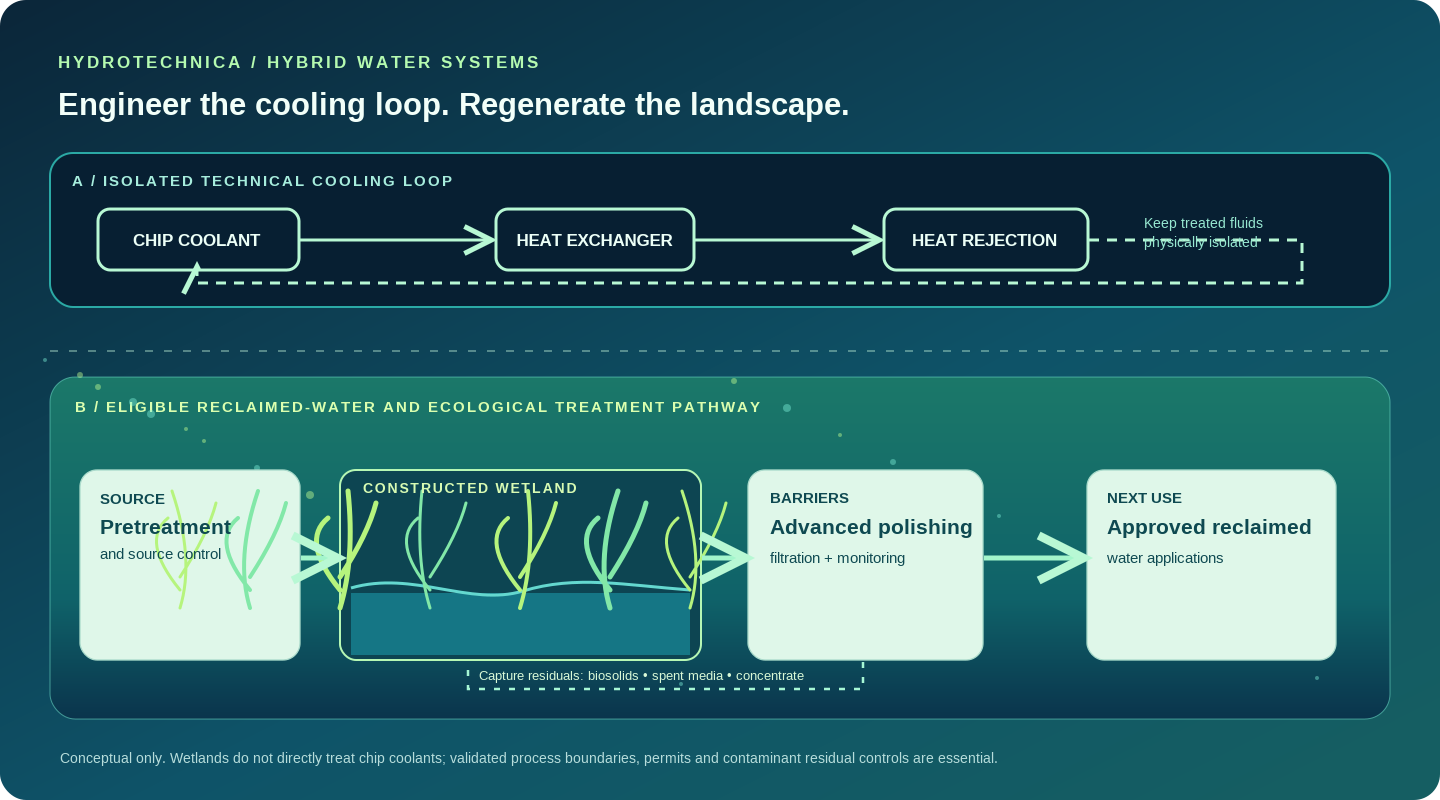
Original conceptual process diagram linking source-water pretreatment, planted treatment cells, monitored advanced polishing, reuse and residuals collection.
Conceptual hybrid system diagram; not a built installation or a certified potable-water process.
THE TECHNOLOGY MAP

Six ecological approaches worth understanding.

Many categories overlap. The important differences are the contaminant mechanism, the treatment stage, the actual monitoring evidence and the residuals that must still be managed.

Nature-based methods belong in accountable watershed planning. Explore the One Water community model ↗ and the technology evidence watch ↗.

01 / LIVING ECOLOGIES

Living Machines & Eco-Machines

Biologically diverse engineered systems use tanks, plants, attached-growth microbes, ecological beds and conventional treatment principles. Designs vary and can require aeration, filters, clarifiers and disinfection.

Explore the Bear River and John Todd lineage ↗
02 / WETLAND ENGINEERING

Constructed wetlands

Surface and subsurface systems combine plants, media and microbial processes to treat approved preconditioned water. They can support nutrient removal and final polishing; capacity is constrained by hydraulics, seasonality, land and maintenance.

Connect to wastewater treatment ↗
03 / ROOT-ZONE SYSTEMS

Phytoremediation

Plants can accumulate, stabilize or help transform certain constituents. Uptake is compound- and species-dependent, often involving root-associated microbial communities. Captured contaminants may remain in biomass or soils.

Explore current field research ↗
04 / BIOLOGICAL PROCESSES

Bioremediation & biofilms

Bacteria, fungi and mixed communities can degrade some organic compounds and transform nutrients under suitable conditions. Salts and many persistent substances cannot be presumed to disappear through biodegradation.

Follow contaminants and residuals ↗
05 / NEXT-GENERATION HYBRIDS

Biochar, electrowetlands & algae

Research explores conductive media, microbial electrochemistry, algae and sorptive substrates to intensify ecological treatment. Pilot findings are promising, but full-scale durability, residue handling and energy use remain central questions.

Read recent papers ↗
06 / DESIGN WITH LANDSCAPES

Water-sensitive site design

Rainwater harvesting, green roofs, bioswales, riparian restoration and vegetated treatment belts can manage selected runoff and support ecosystems. They do not automatically replace engineered treatment of industrial coolants.

See a hybrid data-center concept ↗

Where high-tech and eco-tech intersect

Water challengePotential ecological stageWhen engineered treatment remains essential
Stormwater and runoffVegetated filtration, wetlands, infiltration where suitableContaminated source control, flood safety and monitored discharge
Municipal wastewater effluentSubsurface wetland polishing for selected nutrients and organicsUpstream biological treatment, pathogens, disinfection and required compliance
Industrial process waterSegregated organic/nutrient-rich stream after appropriate pretreatmentHazardous substances, salts, high temperatures and variable loads
Data-center campus waterStormwater landscape, rainwater capture or eligible reclaimed-stream polishingSeparated chip coolant loops, cooling-tower chemistry, corrosion and microbiology
Persistent contaminantsLimited polishing or research-stage plant/microbe interactionsVerified capture, destruction, residue management and fit-for-purpose barriers

Evidence matters as much as biodiversity.

Wetland treatment is not chemical-free by definition; some systems incorporate disinfectants, pH control, aeration and mechanical separators. Plants can improve microbial habitat while accounting for little of a pollutant's direct mass removal. Conventional processes may remain the main source of treatment. We should compare measured influent and effluent quality, loading, energy, land, capital, operation and lifetime maintenance—not simply describe a greenhouse as self-sustaining.

For northern climates, freezing and seasonal plant activity can be design-limiting. For heavy metals or PFAS, contaminated media or plant biomass must not be treated as harmless compost. The technology choice depends on what is actually present in the water and what the next use requires.

Key references

Independent educational content. Treatment claims, reuse permissions and environmental or drinking-water compliance must be verified for each site. Concept illustrations do not represent a built or approved facility.